Stairs: We are better than this, 2017, paper
Foam: Body landscape, 2017, found foam and fishing line
Foam: Body landscape, 2017, found foam and fishing line
Beyond Form Alcoves, 2017
New Tenants, 2017, key collection and nails.
Is this cute yet?, 2017, hands made trash bags and antique jewelry, Astro Turf
A better mousetrap, 2017, found teeth molds, steel, plastic packing bags, found green foam, spring, eyelets, and astro turf
Is this cute yet?, 2017, hands made trash bags and antique jewelry, Astro Turf
A better mousetrap, 2017, found teeth molds, steel, plastic packing bags, found green foam, spring, eyelets, and astro turf
Beyond Form Room Install, The Center, Dallas, 2017
Room 134 Shadow Landscape Vol 3: Dallas, 2017, objects I found on the streets of Dallas, projected and painted shadows.
Blaffer Museum, University of Houston, MFA Thesis Show 2016
Materials: found foam, fishing line, overhead projectors, and herb and food powders in resin
Blaffer Rock Garden 2016
Materials: dental casts, packing plastic, steel
Silos on Sawyer SITE Houston Installation
NOV. 6, 2015 - JAN. 30, 2016
In Silo D-6, I explore the link between people and places with materials I’ve picked up within a five-mile radius of the SITE exhibition. I cast each object’s shadow onto the walls of the silo and trace their outline and form in various mediums, such as chalk, acrylics and spray paint. This results in a landscape, mural-like installation that reflects both the space and its connection to the people who inhabit this area of Houston When a landscape is altered, the act creates a feedback loop between humanity’s alteration of landscape and the landscape’s alteration of infrastructure. With this work, I am building a world that reflects the ongoing battle between the landscape and its decaying infrastructure.
For a virtual tour of the space click here.
For a virtual tour of the space click here.
Ceramics Installation Room 2015 University of Houston
Shadow Landscape
What does a person bring to the landscape? What do they leave behind? There’s a science fiction/fantasy trilogy written by Anne Bishop. It’s about a place that is physically altered by what people feel. Some places resonate with certain people while others don’t. You can cross a bridge and if you are not in the right emotional state end up somewhere else not able to return home. They have a saying in this land “Let your heart travel lightly. Because what you bring with you become part of the landscape.” This idea of there being a link between people and place has me focusing on landscapes and the way humanity has altered the landscape. I’m interested in what happens when these forms are blended together as one. In this piece I have ceramic hands, teeth molds, and plastic body parts in a pile on a drafting table. by projecting shadows on the wall with different colored lights and tracing these shadows on the wall in various media I explore the connection between body and landscape.
What does a person bring to the landscape? What do they leave behind? There’s a science fiction/fantasy trilogy written by Anne Bishop. It’s about a place that is physically altered by what people feel. Some places resonate with certain people while others don’t. You can cross a bridge and if you are not in the right emotional state end up somewhere else not able to return home. They have a saying in this land “Let your heart travel lightly. Because what you bring with you become part of the landscape.” This idea of there being a link between people and place has me focusing on landscapes and the way humanity has altered the landscape. I’m interested in what happens when these forms are blended together as one. In this piece I have ceramic hands, teeth molds, and plastic body parts in a pile on a drafting table. by projecting shadows on the wall with different colored lights and tracing these shadows on the wall in various media I explore the connection between body and landscape.
Ceramics Installation Room 2015 University of Houston
A Landscape for a Wasp
Ceramics Installation Room 2014 University of Houston
Burdened
Participants were asked to pop a balloon, read the secret inside, write a secret on a piece of paper, then stuff and inflate their own balloon.
Participants were asked to pop a balloon, read the secret inside, write a secret on a piece of paper, then stuff and inflate their own balloon.
Avenue L 2012 Huntsville Art Walk-Storefront Installation
(dis'ken-tent)
Dis*con*tent
(dis'ken-tent')
1. One who is discontented
2. A sense of grievance
3. Dissatisfaction
4. Restless longing for better circumstances
5. Absence of contentment
The Gaddis Geeslin Gallery
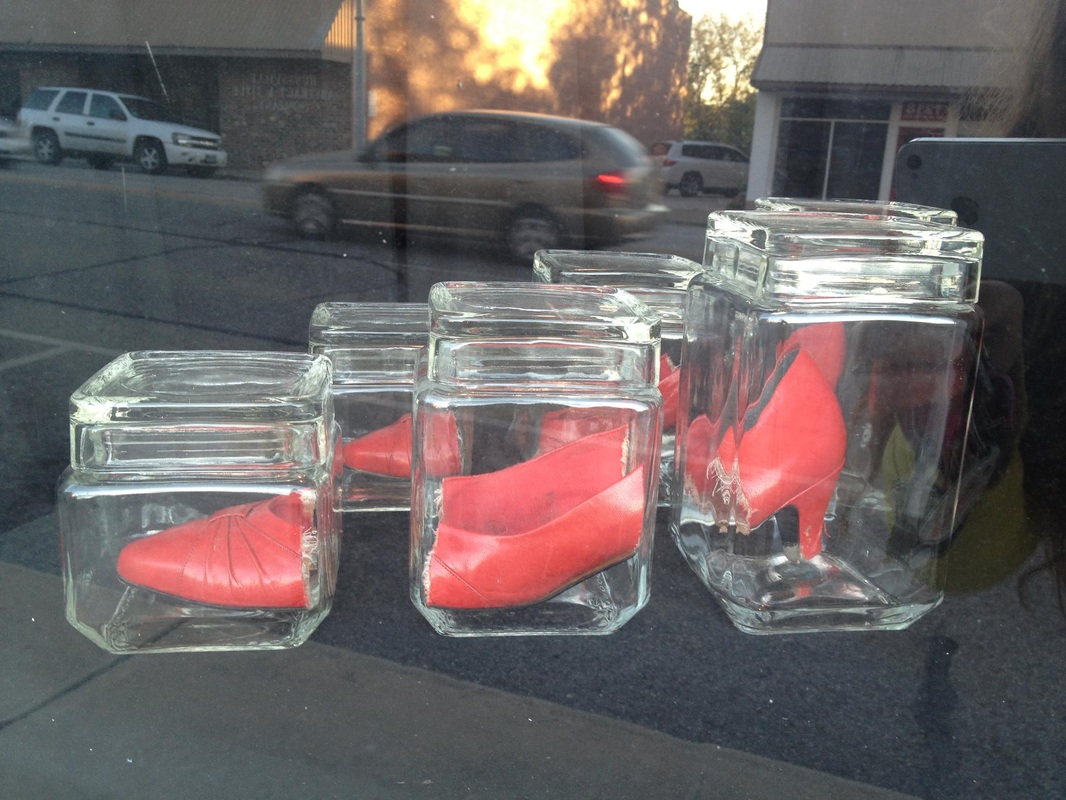
This Distillation of a dress was part of the "Here Today, Gone Tomorrow" Performance Art exhibition at the 3-G gallery in Huntsville, Tx. Six jars hold the reminiscence of the garment that hangs below. The center jar contains a projection of a couple holding hands. This piece is about nostalgia and the need for touchstones.
Artist Statement
Pre-serve
verb (used with object)
to keep alive or in existence; make lasting.
to keep safe from harm or injury; protect or spare.
to keep possession of; retain: to preserve one's composure
to prepare
Like a child with worn out grimy blanket, sometimes we hold on to a memory past its use.
Artist Statement
Pre-serve
verb (used with object)
to keep alive or in existence; make lasting.
to keep safe from harm or injury; protect or spare.
to keep possession of; retain: to preserve one's composure
to prepare
Like a child with worn out grimy blanket, sometimes we hold on to a memory past its use.
Avenue L 2011 Huntsville Art Walk- Window Installation
Showgirls" was featured in the Nov 11, 2011Avenue L Huntsville Art Walk
My installation, Showgirls, explores the ideas of the grotesque and whimsical. I am trying to recapture a time of playfulness with an adult twist:
I remember playing with cicada skins as a child with no hesitations, with no thoughts of how disgusting these insect moltings are. They were just another toy. Now, as an adult, I struggle to touch them with my bare hands. My response to these shells is almost phobic. I have to wear gloves while getting the first coat of paint on. And my "Ew, ew, ew's," can be heard by the neighbors. Once they are painted, though, they become friendlier and each take on a personality. They are no longer repulsive leftovers but figurines to be dressed, and protected.
The Sam Houston Museum
2009 collaboration with Cara Murray and Sarah Bolan.
"In Tempore" was a site specific installation in the Sam Houston State Park. Each framed hourglass was engraved with a member of the Sam Houston household and the sand in them represented the time they each spent on the land.
"In Tempore" was a site specific installation in the Sam Houston State Park. Each framed hourglass was engraved with a member of the Sam Houston household and the sand in them represented the time they each spent on the land.